A Slot-Skinned Instant Game Built Around One Cast
Fish Boom looks like it belongs in the payline slot family: a grid spins, symbols drop into place, a spin button pulses at the bottom of the screen. Play a single round and that impression falls apart fast. There are no paylines to trace, no combinations to match. Every round is a single cast of a hook onto one random tile of a 4x5 board, and whatever sits on that tile is what you get. This is what makes Fish Boom an instant tile-pick game with slot-style presentation, not a payline slot and not a crash game, even though the visual language borrows heavily from both worlds.
That distinction matters more than it sounds. In a real slot, your win depends on matching symbols across a payline. In Fish Boom, the board rebuilds completely before every round, fish tiles get new win values printed directly on them, and the hook simply lands somewhere. You watch the numbers before the cast, which is unusual for this genre, but watching them does not change where the hook falls.
Where the Theme Comes From
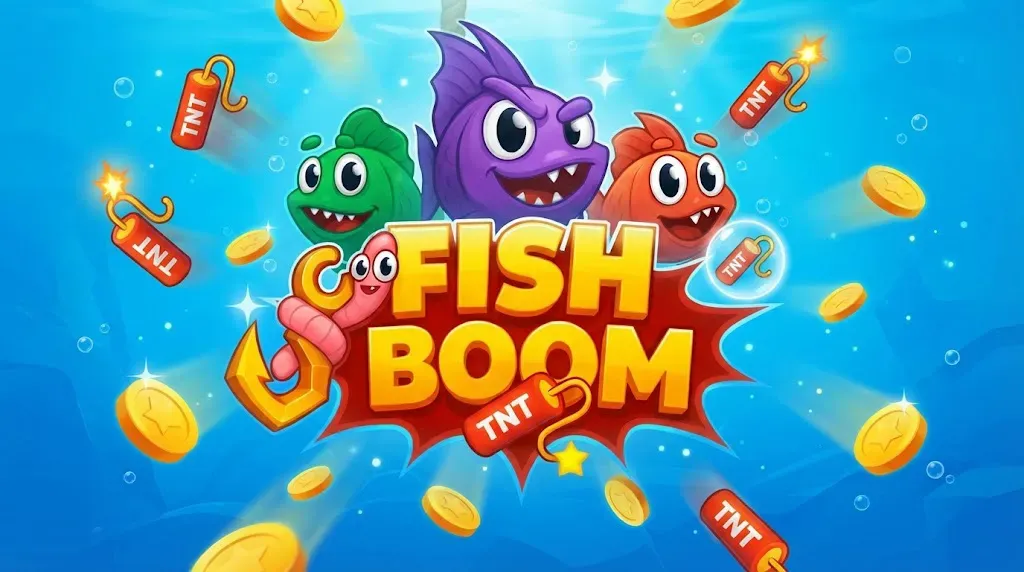
The underwater setting is cartoon fishing pushed toward something louder: a bright reef scattered with colorful fish, oversized Big Fish that stretch across two tiles at once, and TNT charges wired to blow open entire zones of the board. Every round frames itself as one cast of the line, and the explosive elements give the theme its punch. It is a world built for quick visual reads rather than slow-burn atmosphere, which suits rounds that resolve in seconds.
The Studio Behind It
InOut Games built its name on Chicken Road before expanding into a portfolio of 28+ titles, most of them short-cycle games designed to keep players engaged round after round. Fish Boom marks the studio’s move from road-crossing ladder games into slot-flavored instant fishing, and the concept proved sturdy enough that InOut Games later reworked it into Ice Fish, a wheel-based companion title. Provably fair cryptographic verification runs through everything the studio releases, and across its catalogue RTPs sit between 95% and 99%, with content localized into more than 15 languages.
What Actually Happens Inside a Round
A round starts the moment you set your stake and hit spin. The board refreshes from nothing, fish tiles appear with their win values already visible, and then the hook drops. There is no pause for decisions, no cash-out window, no moment where your input changes the outcome. The tension lives entirely in the half-second before the hook lands, because by the time you see the payout, the round has already resolved itself.
The Core Loop
The mechanic InOut Games calls Cast & Catch is the entire game in miniature. You bet, the board rebuilds with visible tile values, the hook drops onto one tile chosen at random, and that tile’s value becomes your payout. Land on an empty tile and you get nothing. There is no chaining, no multiplier climb, no sequence of choices — one cast, one result, then the next round begins.
Big Fish and TNT
Two special elements break the one-tile-one-payout pattern, and they carry most of the game’s excitement.
- Big Fish — a large fish occupying two tiles at once. Hook either occupied tile and both values pay out together, effectively merging two prizes into a single catch.
- TNT — dynamite planted on the board. Hit it and the explosion cashes out the entire 3x3 zone surrounding it, up to nine tiles’ worth of values in one round. This is the single biggest swing available in the base game, and it is the moment every regular player is quietly hoping for on each cast.
The Free Spins Meter
Unlike slots that trigger bonus rounds through symbol combinations, Fish Boom wraps a meter around the spin button that charges with every base-game spin. Fill it and a mini event fires, awarding somewhere between 2 and 50 Free Spins with Big Fish and TNT boosters both still active. There is a real fairness in this design: you are not waiting on a lucky scatter pattern, you are simply spinning enough times. The trade-off is that the meter locks during Free Spins, so the feature cannot retrigger itself, and any spins played with Bonus Bet active do not add anything to that meter at all.
Bonus Bet and TNT Spin
Two optional paid modes sit alongside the base game, and they solve different problems.
- Bonus Bet doubles your base wager to seed more TNT symbols onto the board. It raises your chances of seeing dynamite, but landing the hook on it is still down to luck — the extra cost buys opportunity, not a guarantee. With Bonus Bet switched on, the base bet caps at $100, pushing the total cost per round to $200.
- TNT Spin is a direct purchase that guarantees a dynamite hit on that cast. It is disabled during Free Spins, and it does not guarantee a big payout on its own — the values sitting inside the 3x3 zone still decide what you actually win. Anyone weighing whether that purchase makes sense for a given session should look at the tier breakdown on the bonus buy page before committing real money to it.
Reading the Math Without Fooling Yourself
Fish Boom runs on an RTP of 96.3% under its 2025 math model, a figure that sits above most step-multiplier instant games in this category. That number means the game returns 96.3% of everything wagered back to players over a long enough stretch, while keeping about 3.7% for itself. It says nothing about any single session, and it says nothing about whether the next hook lands on a fat tile or an empty one.
Why Visible Tiles Are Not an Edge
Seeing every possible win value printed on the board before you cast feels like information you can use. It is not. The tile weights that decide where the hook is likely to land are already baked into that 96.3% figure, so the visibility is transparency, not an advantage. You know what is at stake before the round resolves, which is honestly rare in this genre, but knowing the stakes and predicting the outcome are two different things entirely.
What Bonus Bet and TNT Spin Change, and What They Don’t
This is worth being blunt about, because it is where players talk themselves into bad assumptions:
- Bonus Bet doubles your cost per round and increases the odds of seeding TNT onto the board. It does not raise the RTP. It shifts variance upward, nothing more.
- TNT Spin guarantees a dynamite hit, which guarantees a 3x3 zone payout. It does not guarantee that zone contains large values, so it is a purchase against variance, not a purchase of profit.
- Free Spins are a pacing mechanic funded by the base game’s own math, not a jackpot bolted on top. The meter guarantees the feature will arrive eventually; it does not guarantee what that feature pays.
The Win Cap and What It Means at Higher Stakes
Fish Boom’s maximum win is a fixed $/€20,000 per round, not a multiplier of your bet. That distinction punishes high-stakes players more than it seems at first glance: the effective ceiling as a multiple of your stake shrinks the larger you bet, since the cap itself never moves. A player betting near the low end of the range has enormous multiplier headroom before hitting that number; a player near the top of the bet range can bump into the ceiling on a single strong TNT explosion.
Volatility in Practice
The game runs medium volatility, shaped by the internal weighting given to each tile value rather than by any external multiplier trail. Bonus Bet pushes a session toward higher variance by seeding more TNT chances at double the cost, which means swings get sharper in both directions when it’s switched on. Medium volatility in an instant-resolve game like this translates into stretches where tiles pay small and steady, interrupted by the occasional Big Fish or TNT hit that reshapes the session in one cast. Understanding that rhythm before you sit down to play, rather than mid-session, is exactly the kind of groundwork covered in more depth on the strategy page.
Sitting Down for a Session
Rounds resolve in a few seconds each, and there is nothing to decide once the hook drops. That combination — visual richness with zero mid-round agency — produces a session character closer to classic instant games than to a slow-burn slot. The sound design adds a satisfying pop to every catch, and turbo mode plus autoplay push the pace up further for players who want speed over ceremony.
Setting Your Stake and Modes
Bets run from $0.10 up to $150 at the base level, with some configurations accepting stakes as low as $0.01 depending on the operator. Three control modes cover different play styles: a standard spin for players who want to watch every cast, hold-to-turbo for rapid-fire rounds, and autoplay with a customizable spin count for hands-off sessions. The settings panel also houses the rules and the provably fair verification tools, so the fairness check is never more than a tap away.
Where and How It Runs
Fish Boom is built entirely in HTML5/JS, meaning it runs directly inside desktop and mobile browsers with no download required, at a lightweight footprint of roughly 30.5 MB. It supports iOS through Safari and Chrome, Android through Chrome and other browsers, and standard Windows or macOS browsers on desktop. The layout is portrait-first, with large touch targets around the spin and Bonus Bet controls and strong visual contrast that keeps fish, TNT and winning tiles readable on a small screen. Full details on getting it running smoothly on a phone, including the home-screen shortcut option, sit on the mobile play page.
One thing worth saying plainly: there is no standalone Fish Boom app, and there never has been. Any APK file or app-store listing claiming to offer one is not an official product. The game exists only as an in-browser HTML5 client, whether you’re accessing it through a mobile browser or through a casino app that carries the InOut Games portfolio.
Weighing What the Game Does Well Against What It Doesn’t
No instant game is built without trade-offs, and Fish Boom’s are worth naming directly rather than glossing over.
The Strong Points
The 96.3% RTP outperforms most games in this step-based instant category, and the board’s full transparency — every tile value visible before the cast — is a genuinely rare level of directness for this genre. Big Fish and TNT give the base game real texture instead of flattening every round into an identical single-tile pick, and the guaranteed-over-time Free Spins meter means the feature never depends on a lucky combination landing. Provably fair verification backs every round, the bet range and three control modes suit both careful players and speed players, and the demo runs the exact same math and boosters on a virtual balance.
The Real Limitations
The absence of any mid-round decision cuts both ways: it keeps the pace fast, but it also means there’s no cash-out to time and no skill to apply once the hook drops. Not every tile hosts a fish, so a hook landing on empty space paying nothing is a normal, expected outcome rather than a rare bad break. The fixed $20,000 win cap hits high-stakes players harder than low-stakes ones, Free Spins cannot retrigger from inside themselves, and Bonus Bet rounds never contribute to that meter — so chasing Free Spins and using Bonus Bet are, in practice, opposing goals. Bonus Bet itself doubles round cost without any guarantee of a TNT hit, which is the single feature most likely to drain a bankroll faster than a player expects.
Fairness, Randomness, and the Predictor Question
Every outcome in Fish Boom — the board layout, the hook’s landing tile, TNT placement, and the Free Spins award — comes from a certified random number generator, with results independent between rounds. The provably fair system lets you cryptographically verify any round after it resolves, confirming that the tile layout and outcome were fixed before your bet was placed and never altered afterward. That’s the honest answer to whether Fish Boom is rigged: the software is certified against regulatory requirements across multiple gaming jurisdictions, and the verification tool exists specifically so you don’t have to take that claim on faith.
It’s also the honest answer to predictor apps and signal channels claiming to know where the hook will land or when TNT will appear. They are scams without exception. No external tool has server access to Fish Boom, and the entire point of a provably fair system is that outcomes are cryptographically fixed before the round begins, not something readable in advance by anyone, anywhere. If you want to see how the tile-weight distribution actually behaves without risking anything, the free demo runs the identical math model and boosters on a virtual balance, and it is the only legitimate simulator worth trusting.
Fish Boom earns its place in this instant-game category through honesty of presentation more than through raw ceiling size: a 96.3% RTP, a board that shows its cards before every cast, and a Free Spins meter that never leaves you waiting on luck alone. What it does not offer is control once that hook starts falling, and no amount of Bonus Bet or TNT Spin purchases changes that basic fact. Play it for what it actually is — a fast, transparent, single-cast game with real explosive moments built in — set your limits before you start, and let the reef do what it’s built to do.