
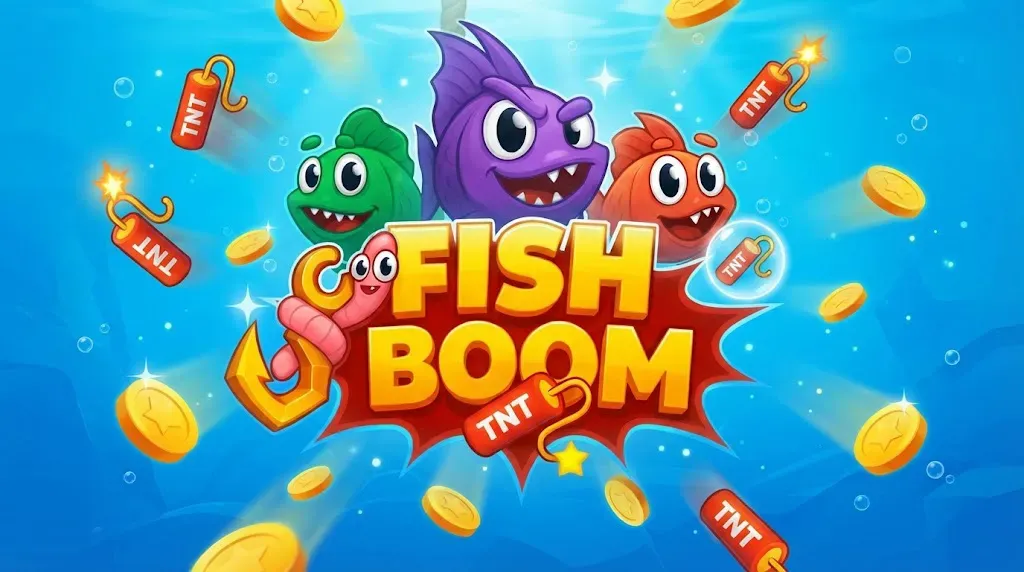

A virtual balance that runs the real math model
The demo of Fish Boom is not a stripped-down taste of the game — it is the same 4x5 board, the same tile weights, the same 96.3% RTP math model, and the same booster set, just funded with credits instead of your own money. That distinction matters more than it sounds. A lot of instant-style games water down their free versions, capping features or swapping in friendlier odds to make the trial feel more generous than the real product. Fish Boom does not do that. What you see in demo mode is what you get once you switch to cash bets, tile for tile.
That consistency is why demo play is worth taking seriously rather than treating as a formality before you deposit. You are not learning a simplified version of the game — you are learning the actual game, at zero risk, for as long as you want.
What stays identical to real-money rounds
Every mechanical piece of Fish Boom carries over untouched. The board still rebuilds fully each round with fresh fish values printed directly on the tiles. The hook still drops onto a single random tile once you spin, and that tile alone decides the payout. Big Fish still spans two tiles and pays for both when hooked. TNT still detonates a 3x3 zone around itself for up to nine tiles’ worth of value in one catch. The Free Spins meter still charges with every spin and still awards 2 to 50 Free Spins once it fills, with no retriggers once that feature starts.
The optional add-ons are live too. You can toggle Bonus Bet in demo mode to see how doubling the wager seeds more TNT into the layout, and you can trigger a TNT Spin to watch a guaranteed dynamite hit play out without spending anything real. The provably fair verification panel is also accessible, so you can check the cryptographic proof behind demo rounds the same way you would for cash ones.
What changes with virtual credits
The only thing that changes is what is at stake. Your balance is virtual, resets are usually available, and nothing you accumulate in demo mode transfers to a real account. There is no withdrawal path from demo credits, and no deposit is required to access it — it exists purely as a no deposit play environment for learning the game’s rhythm and structure.
Why a decision-free game still benefits from a trial run
It might seem odd to practice a game where you make no choices mid-round. The hook drops, the tile resolves, and that is the entire event — there is no cash-out timing, no hold decision, nothing to react to once you press spin. So why bother with demo play at all?
Reading the board before it costs anything
The value comes from familiarity with what the board actually shows you. Fish Boom prints every possible win directly on the tiles before the hook casts, and bigger prizes tend to sit deeper in the grid. Spending time in demo mode lets you get comfortable reading that layout quickly — recognizing a Big Fish spanning two cells, spotting where TNT sits relative to the 3x3 blast zone it would trigger, and getting a feel for how often tiles come up empty. None of this changes the outcome, since the hook lands randomly regardless of what you notice, but understanding the board makes the visual side of the game make sense rather than feeling like noise.
Feeling out the Free Spins meter’s pace
The meter wrapped around the spin button fills with every base-game spin and guarantees a Free Spins event over time. Watching that meter build during a trial session gives you a realistic sense of how many rounds it typically takes to fill, so you are not caught off guard by how the pacing works once real stakes are involved. Demo play also makes it obvious that Bonus Bet rounds do not contribute to that meter — something easy to miss if you only read the rules and never actually watch it happen.
Testing the control modes without pressure
Fish Boom offers three ways to play: standard spin, hold-to-turbo for faster rounds, and autoplay with a customizable spin count. Demo mode is the natural place to figure out which pace suits you. Turbo and autoplay both accelerate how quickly credits move, virtual or not, and getting a feel for that speed before you attach real money to it is a genuinely useful habit. For the full rundown of controls and round structure, the how to play guide covers the mechanics in more depth than a trial session alone will teach you.
Setting up a demo session
Getting into demo mode does not require an account, a deposit, or any commitment. Because Fish Boom runs on a lightweight HTML5/JS client of about 30.5 MB, it loads quickly in a browser tab, whether you are on desktop or a phone.
Steps to start a trial round
- Open the game client in demo mode, which loads directly with a virtual balance already in place.
- Set a stake within the demo interface, mirroring the real bet range even though nothing is deducted from actual funds.
- Decide whether to leave Bonus Bet off or switch it on to see how it changes the board’s TNT density.
- Press spin, or switch to hold-to-turbo or autoplay if you want to see multiple rounds play out quickly.
- Watch where the hook lands, note whether it caught a Big Fish, triggered TNT, or hit an empty tile, and keep an eye on the Free Spins meter’s progress.
Practicing on mobile without an app
There is no standalone Fish Boom app, and none is needed. The demo runs the same portrait-optimized, HTML5 interface in a mobile browser as it does inside a casino platform carrying the InOut Games library. Large touch targets for the spin button and Bonus Bet toggle, strong tile contrast, and stable performance on mid-range phones all apply to the demo just as they do to real-money play. If a shortcut on your home screen is useful, the game page can be pinned there for a quicker, fullscreen-style launch. Be wary of anything claiming to be a downloadable Fish Boom app or APK — the game exists only as an in-browser client, and the app page goes into more detail on what legitimate access actually looks like.
What demo mode cannot teach you
It is worth being direct about the limits of a trial. Demo play is genuinely useful for understanding structure and pacing, but it cannot teach you anything about beating the game, because there is nothing to beat in the way a skill-based game can be beaten.
No amount of practice changes the odds
Every round in Fish Boom is settled by a certified random number generator — the board layout, the hook’s landing tile, TNT placement, and the Free Spins award are all generated independently, round to round. Practicing in demo mode does not build pattern recognition that transfers into an edge, because there is no pattern to recognize. The tile values you see are transparency, not a signal; the weighting behind them is already priced into the 96.3% RTP, and that number describes long-term return, not what happens in any single session you or anyone else plays.
Demo as the only legitimate simulator
This is precisely why the official demo is worth using in place of anything claiming to predict outcomes. Tools or channels claiming to know where the hook will land, or when TNT is about to appear, have no access to the game server and cannot know anything the provably fair system has not already fixed cryptographically before the round starts. If you want to understand more about why those claims do not hold up, the predictor page addresses that directly. The demo, by contrast, does not pretend to forecast anything — it simply lets you experience the actual math model with credits that carry no financial weight.
Moving from trial credits to a funded session
At some point, most players who enjoy the trial want to know what changes when real stakes enter the picture. The honest answer is: nothing about the math, only what is on the line.
Carrying habits over responsibly
Whatever pacing or control mode felt comfortable in demo mode is worth carrying over, but budget discipline needs to be decided fresh, because virtual credits do not teach you anything about real loss limits. Rounds resolve in seconds, and turbo or autoplay can burn through a bankroll far faster than it feels in the moment. Deciding a session budget, a round count, and a walk-away point before switching to real bets is the single most useful thing a demo session cannot do for you on its own — that discipline has to be applied deliberately once money is involved, and the responsible gaming page has tools for setting those limits.
Thinking about stake size after practicing
Having watched tile values and the meter’s pace in demo mode, you will have a clearer sense of what a comfortable stake feels like once real money replaces virtual credits. Lower stakes keep the $/€20,000 win cap further away and preserve the full value of Big Fish and TNT hits relative to your bet, which is a detail worth remembering once you move past practice. Reviewing how the mathematics behind the game actually behaves — RTP, variance, and what Bonus Bet does and does not change — is covered thoroughly on the strategy page, and it pairs naturally with what a demo session shows you firsthand.
Treat the trial as what it is: a genuine, unaltered look at how Fish Boom plays, free of cost and free of consequence. Use it to get comfortable with the board, the meter, and the pace, and carry that familiarity — not any illusion of an edge — into whatever you decide to do next.