
What Strategy Actually Means on a One-Cast Board
Every so-called strategy conversation about Fish Boom has to start with an uncomfortable truth: there is no moment inside a round where a decision changes the outcome. You set your stake, you press spin, the board rebuilds with fresh tile values, and the hook drops onto one random tile. That is the entire round. No cash-out timing, no picking which tile to hook, no mid-round choice of any kind. So when people search for the best strategy or a winning strategy for this game, what they are really after is understanding the math well enough to play it smart, not a system that beats it.
Why the Visible Tile Values Are Not an Edge
One thing that trips people up is the board itself. Every tile shows its win value before the cast, and that transparency feels like it should mean something. It does not change your odds. The hook’s landing spot is random, and the weighting behind each tile value is already baked into the 96.3% RTP. Seeing a big number on a tile deep in the grid doesn’t make it more or less likely to get hooked than a small one nearby. The visibility is honesty about what’s at stake, not a signal you can read.
The 96.3% RTP and What It Costs You Over Time
The game’s 2025 math model runs at 96.3% RTP, meaning that across a large enough sample of rounds, the game returns about 96.3% of everything wagered and keeps roughly 3.7% for itself. That 3.7% doesn’t show up round by round — you might hit a Big Fish or a TNT zone on your third spin and feel like the math is working in your favor. But every single mode, including Bonus Bet and TNT Spin, carries that same negative expectation. There’s no toggle that flips it positive.
Reading the Board Mechanics Before You Bet
Before any tactics conversation makes sense, you need to know what’s actually sitting on that 4x5 grid, because two features do most of the heavy lifting when a session goes well.
Big Fish and TNT as the Two Real Multipliers of Value
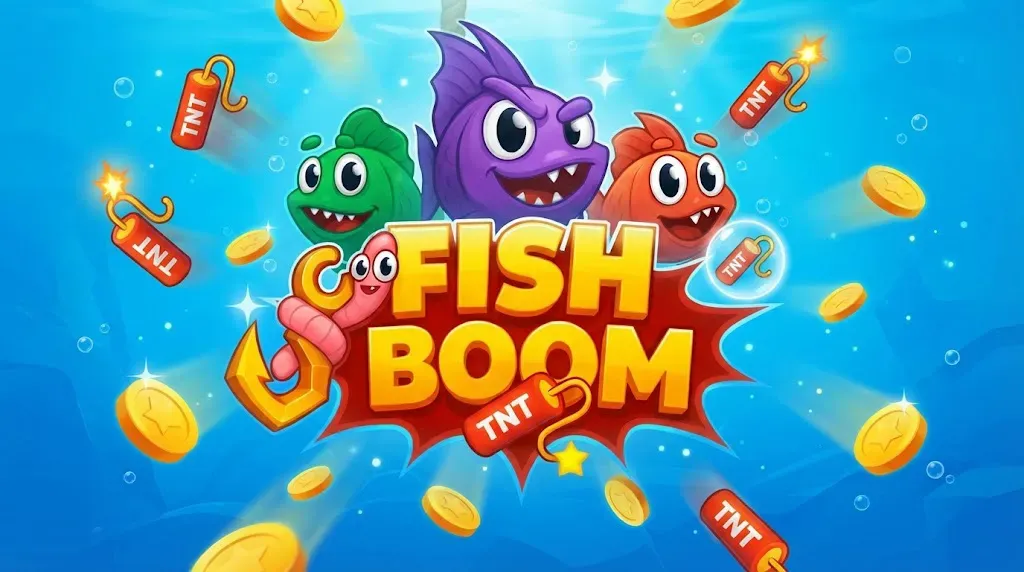
A Big Fish spans two tiles at once, and hooking either occupied spot pays for both — effectively merging two win values into a single catch. TNT works differently: it doesn’t just pay its own tile, it detonates the entire 3x3 zone around it, cashing out up to nine tiles in one round. These two mechanics are where the real variance lives. A plain fish tile pays what it shows. A TNT hit can turn a modest board into a genuinely strong round because it’s harvesting eight neighboring tiles along with itself.
The Free Spins Meter as a Pacing Tool, Not a Jackpot
Every spin — standard ones, that is — charges a meter wrapped around the spin button. Once it fills, a mini event triggers and hands you somewhere between 2 and 50 Free Spins, with Big Fish and TNT boosters still active. This isn’t luck-based in the symbol-combination sense; it’s a guaranteed pacing mechanic that arrives on a predictable cadence the more you spin. The catch is that the meter locks during Free Spins, so the feature can’t retrigger from inside itself, and it stops charging entirely if you’re running Bonus Bet rounds.
Bonus Bet and TNT Spin, and Where People Misjudge Them
These two paid options are the closest thing to a decision Fish Boom gives you, and they’re also where most misunderstandings about betting strategy happen.
What Bonus Bet Actually Changes
Bonus Bet doubles your base wager to seed more TNT symbols onto the board. It genuinely raises your chances of encountering dynamite. What it does not do is improve the RTP — the extra cost simply shifts variance upward, nothing more. The base bet caps at $100 with Bonus Bet active, bringing the total round cost to $200. If you decide to use it, halving your base stake first keeps your cost per round where it was before you turned it on; otherwise you’re just betting twice as much and calling it a tactic. It’s also worth remembering that Bonus Bet rounds do not contribute to the Free Spins meter at all — so if you’re chasing that feature, standard spins are the better path, not Bonus Bet.
TNT Spin as a Guarantee With a Catch
TNT Spin is a purchasable round that guarantees a dynamite hit on the cast. That sounds like a shortcut to a big win, but a guaranteed explosion is not a guaranteed profit — the values sitting in that 3x3 zone still decide what you actually collect, and those values are still generated randomly. TNT Spin is unavailable during Free Spins, so it only exists as a base-game purchase.
Betting Range, the Win Cap, and Why Stake Size Matters
The mechanics matter, but so does the number you type into the stake box, and this is where a lot of practical strategy actually lives.
The Bet Range and What It Means for Session Length
Stakes run from $0.10 up to $150 as a base bet, with some configurations accepting bets as low as $0.01 depending on the operator. That’s a wide spread, and it matters because the game’s rhythm is fast — rounds resolve in seconds, and turbo or autoplay push the pace even harder. A wider stake range gives you more control over how long a fixed bankroll actually lasts, which is the only lever you truly have.
Why the $20,000 Win Cap Shrinks as Your Bet Grows
Fish Boom pays out against a fixed money ceiling of $/€20,000 per round, not a multiplier of your bet. That distinction matters more than it looks. On a step-multiplier instant game, the cap scales with your stake. Here it doesn’t — so the higher you bet, the smaller your effective maximum multiplier becomes, because you’re chasing the same fixed number with a bigger denominator. Players betting near the $150 ceiling hit that cap’s practical limit far sooner than someone playing small.
Building an Actual Session Plan
None of this changes the outcome of any single round, but it does change how sensibly you can play across many of them, which is really what “best time to play Fish Boom” and similar questions are actually asking about — there’s no clock-based edge, only session discipline.
Setting Limits Before You Start
Decide your session budget and a rough round count before you open the game, not while you’re playing. Hold-to-turbo and autoplay accelerate spend far faster than it feels in the moment, because rounds that take seconds don’t give your brain the natural pause a slower game would. Setting a fixed spin count on autoplay, rather than letting it run open-ended, keeps that acceleration in check. If you want to see how the tile-value distribution and the meter’s pace actually feel before risking anything, the demo runs the identical math model and boosters on a virtual balance, and it’s the only legitimate way to get a feel for pacing without real stakes attached.
What Doesn’t Work, and Why
There’s nothing to time and nothing to aim at. The board’s spin and the dropping symbols are presentation — the hook’s landing tile is chosen by a certified random number generator, independent of anything that happened on the previous round. Betting systems like martingale, streak-chasing, or looking for a “hot board” have zero effect here, because each round is mathematically independent and the game carries a fixed negative expectation regardless of your wager pattern. Anything claiming to know where the hook will land before you cast — including so-called predictor tools — is operating on a false premise, since outcomes are fixed cryptographically before the round even starts, not readable in advance by any outside system.
Using Provable Fairness as a Check, Not a Forecast
Every round can be verified after the fact through the game’s provably fair system, which proves the tile layout and outcome were locked in before your bet, not adjusted afterward. This is a trust tool, not a prediction tool — it tells you the round you already played was fair, it doesn’t tell you what the next one holds. If you ever want to build genuine confidence in the mechanics before wagering, understanding the full round sequence on the how-to-play page pairs well with what’s covered here, since knowing the exact sequence of stake, spin, and hook makes the math easier to trust rather than second-guess.
Strategy here really comes down to three things you actually control: how much you stake, how you use Bonus Bet and TNT Spin relative to their real cost, and how disciplined you stay about session limits when the pace of the game wants to push you faster than you’d choose on your own. Everything else — the tile the hook lands on, whether TNT shows up, how big the next Free Spins package turns out to be — is decided by the RNG the instant you press spin, and no amount of tactics changes that. Play it for what it is: a fast, transparent, honestly-built instant game with real variance in Big Fish and TNT, a fixed house edge like any other casino game, and no hidden lever waiting to be found.